
Powerspex's Atex knowledge is currently being put to full use producing loading arms for JLA Loading Technology. This results in good cooperation between the hardware engineers and the Atex specialists within Powerspex.
"Specifically, it means that Erwin Scheggetman and Berend Flier often have to sit down with the hardware engineers for a suitable solution of existing panels in hazardous areas," Robin ten Damme says of the project. "So the knowledge of Atex at Powerspex is now deployed by the hardware engineers."
About JLA
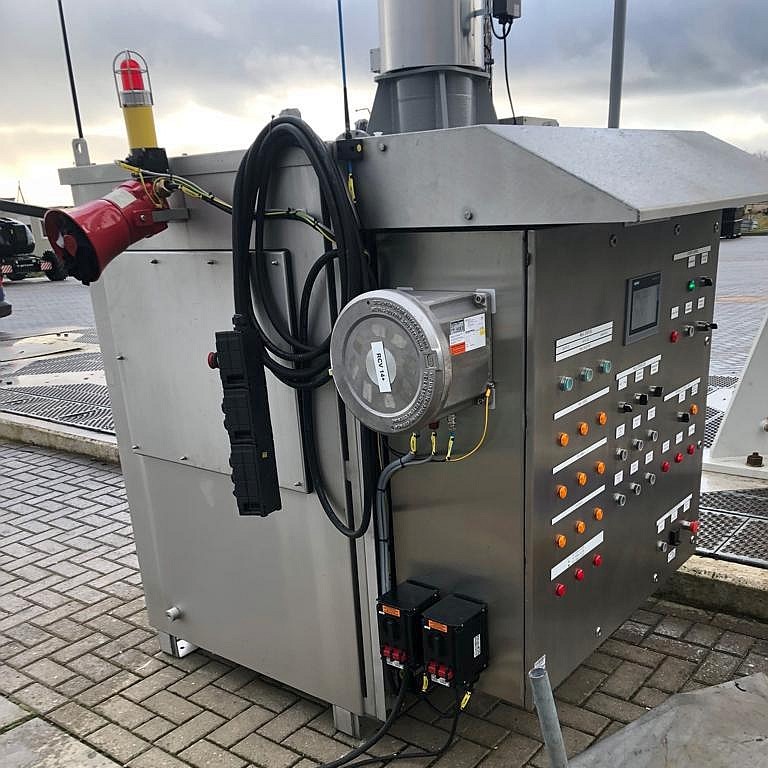
JLA Loading Technology is a company that makes loading arms for ports, where ships can be unloaded, both with liquids and solids. These units consist of an HPU (hydraulic unit), one or more HCMs (the loading arms themselves) and an associated LCP (local control panel).
Ten Damme: "Depending on the liquid, in most cases the unit is built in an ATEX environment. This has set up a nice collaboration internally between the hardware engineering and the Atex departments within Powerspex."
Good cooperation
The Hengelo-based company Holland Hydraulics is the link between JLA and Powerspex.
"It turns out to be a very good cooperation, from both sides. We are working on eight different assignments and have now delivered three. Most recently where we delivered an EX-D/E combination with a remote controller for the first time."
Atex engineering can be seen very concretely on the remote controller: this is what an explosion-proof device looks like.

All over the world
The control panels for JLA are made in our own workshop. The hydraulic units are assembled at Powerspex or at Holland Hydraulics. Then they go to Vlaardingen where JLA manufactures the loading arms itself. These loading arms then go all over the world. Often to the Middle East, because of the large number of fuel transfer locations there.
